What it brings
Short carbon fibre sharpens features, increases modulus and improves dimensional stability. It is an excellent material for precise fixtures, adapters and technical housings where rigidity matters more than ductility.

Short carbon fibre sharpens features, increases modulus and improves dimensional stability. It is an excellent material for precise fixtures, adapters and technical housings where rigidity matters more than ductility.
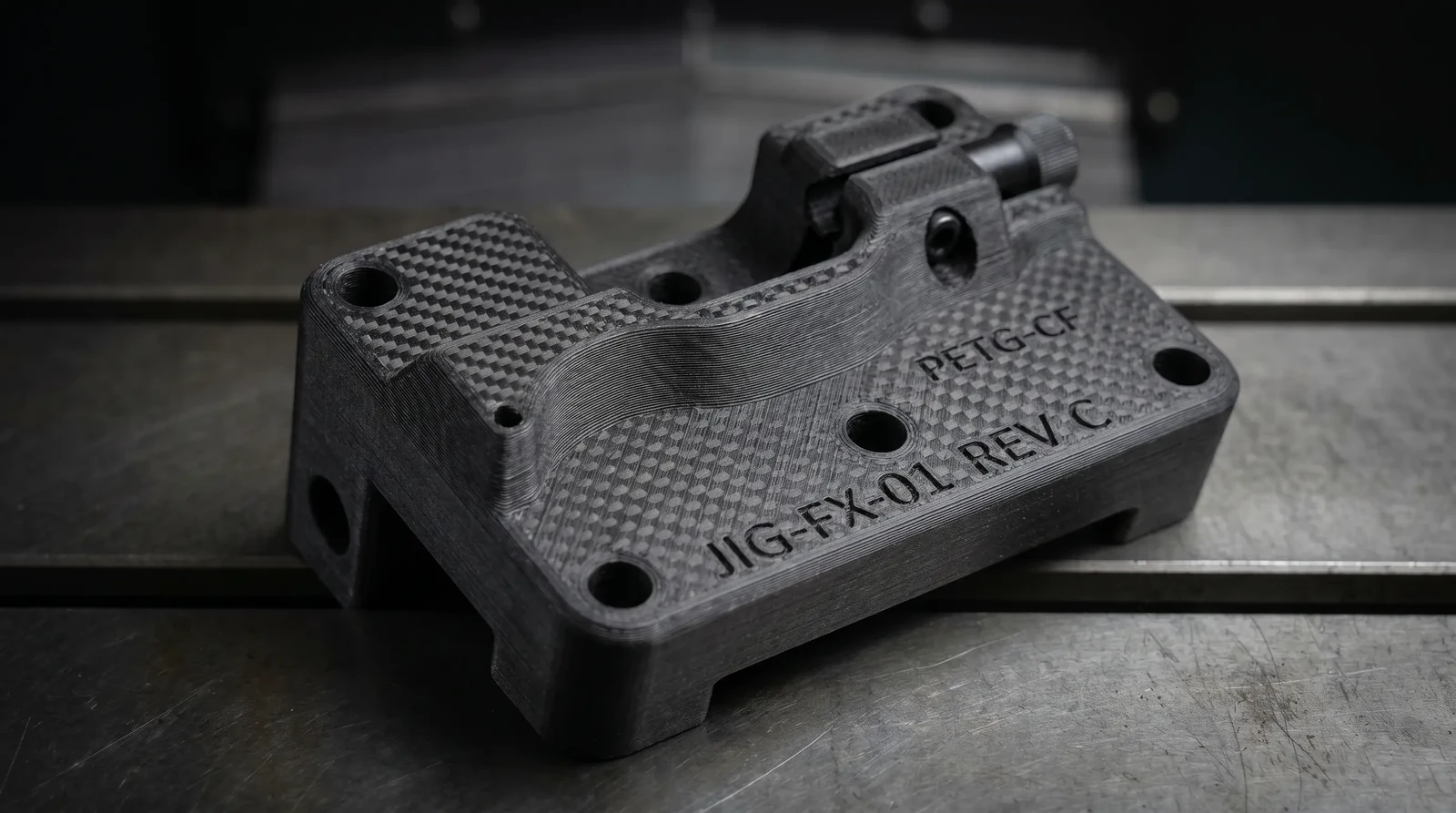
Material family names are not specifications. This page anchors the discussion to a named commercial grade and published printed-specimen data, then translates that data into practical selection and design guidance.
Short carbon fibre sharpens features, increases modulus and improves dimensional stability. It is an excellent material for precise fixtures, adapters and technical housings where rigidity matters more than ductility.
Choose PETG-CF for crisp, rigid, low-warp parts without moving into a high-temperature nylon process.
Orientation, conditioning and geometry can move finished-part performance materially. Use these figures to compare candidate materials—not as guaranteed minimums.
| Property | Representative value | Test / context |
|---|---|---|
| Density | 1.30 g/cm³ | ISO 1183 |
| Tensile strength · XY | 59.8 ± 0.3 MPa | ISO 527 |
| Young’s modulus · XY | 3.71 ± 0.15 GPa | ISO 527 |
| Elongation at break · XY | 5.7 ± 1.0% | ISO 527 |
| Flexural modulus · XY | 3.78 ± 0.04 GPa | ISO 178 |
| Flexural strength · XY | 94.6 ± 1.3 MPa | ISO 178 |
| Notched Charpy · XY | 4.0 ± 0.9 kJ/m² | ISO 179 |
| HDT · 0.45 MPa | 68.6°C | ISO 75 |
XY values normally represent flat-printed specimens. Z-direction strength can be substantially lower. Final production settings should be qualified on representative geometry.
A useful material choice starts with load case, temperature, environment, duty cycle and failure consequence—not the strongest number on a datasheet.