
High-temperature carbon-fibre polyester
PET-CF

PET-CF: Exceptional heat resistance, low moisture uptake and dimensional stability for precision structures.

PET-CF uses a semi-crystalline PET matrix reinforced with chopped carbon fibre. Unlike PETG-CF, it is engineered for high heat: the reference grade publishes a 205°C HDT while retaining low warpage, high flexural stiffness and only 0.37% saturated moisture uptake.

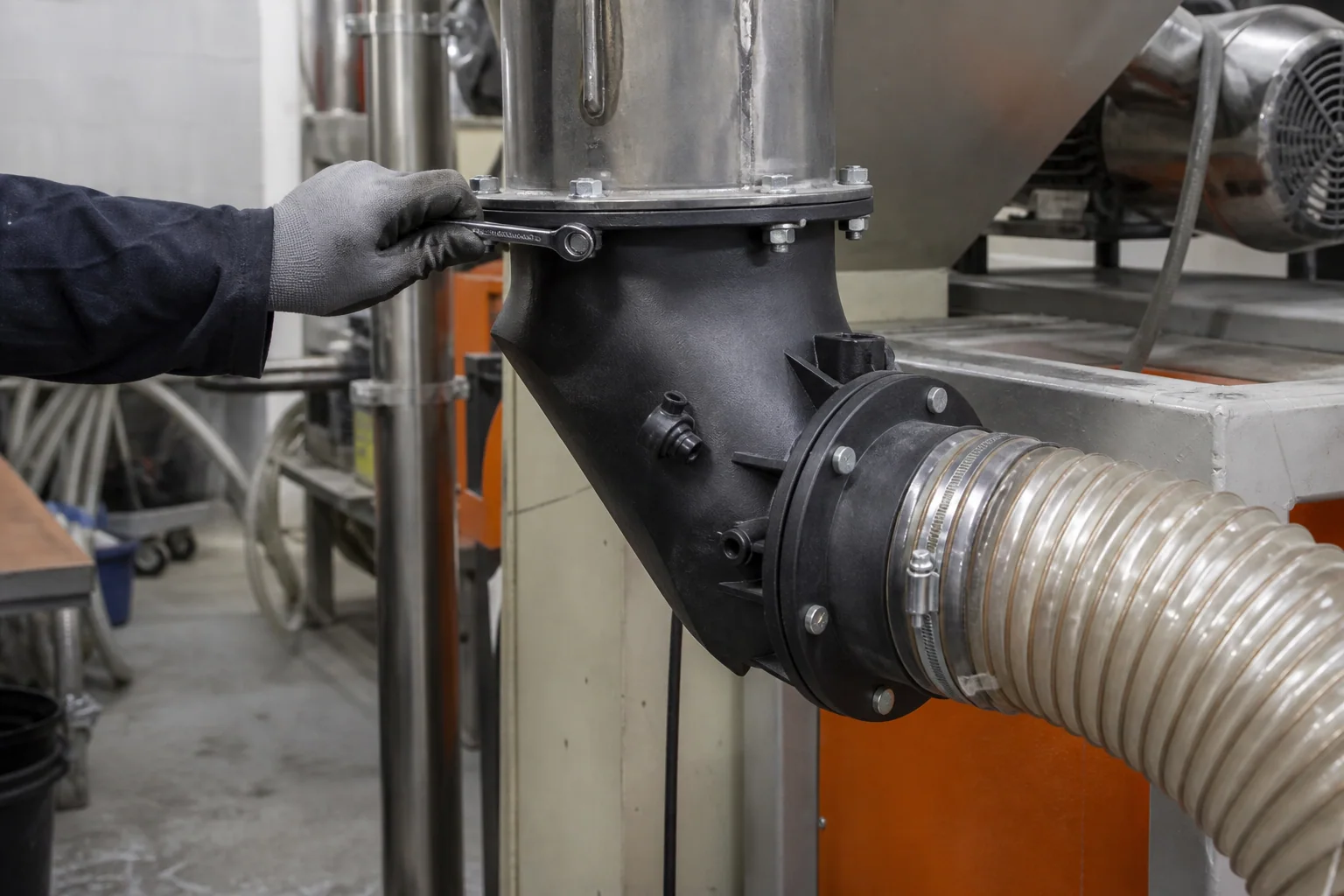
PET-CF printed hot-air transition duct installed between an industrial dryer and flexible process hose
Representative applicationHeat-capable transition duct and sensor manifold for process equipment

The engineer’s read.

Material family names are not specifications. This page anchors the discussion to a named commercial grade and published printed-specimen data, then translates that data into practical selection and design guidance.

What it brings

PET-CF uses a semi-crystalline PET matrix reinforced with chopped carbon fibre. Unlike PETG-CF, it is engineered for high heat: the reference grade publishes a 205°C HDT while retaining low warpage, high flexural stiffness and only 0.37% saturated moisture uptake.

Selection verdict

Choose PET-CF for rigid, precise, heat-exposed structures where nylon moisture movement is undesirable.

Printed properties.

Orientation, conditioning and geometry can move finished-part performance materially. Use these figures to compare candidate materials—not as guaranteed minimums.

PropertyRepresentative valueTest / context
Density1.29 g/cm³Manufacturer TDS
Tensile strength74 ± 6 MPaManufacturer TDS
Elongation at break4.5 ± 1.2%Manufacturer TDS
Flexural modulus · XY5.32 ± 0.27 GPaManufacturer TDS
Flexural strength · XY131 ± 6 MPaManufacturer TDS
Impact strength · XY36.0 ± 2.7 kJ/m²Manufacturer TDS
HDT · 0.45 MPa205°CISO 75
Vicat softening226°CISO 306
Saturated moisture uptake0.37% · 25°C / 55% RHManufacturer method

XY values normally represent flat-printed specimens. Z-direction strength can be substantially lower. Final production settings should be qualified on representative geometry.

Selection logic.

A useful material choice starts with load case, temperature, environment, duty cycle and failure consequence—not the strongest number on a datasheet.

Advantages

  • Very high heat-deflection temperature for a printable composite
  • Low saturated moisture uptake and strong wet-state retention
  • Excellent dimensional stability, creep resistance and low warpage
  • High flexural stiffness for precision jigs and load-bearing structures

Watch-outs

  • More brittle and lower in layer toughness than PAHT-CF
  • Lower impact tolerance than the toughest nylon composites
  • High stiffness makes notch and sharp-corner design especially important

Strong applications

High-temperature fixturesPrecision inspection toolingAutomotive structuresHumid-service bracketsLoad-bearing machine partsDimensional master aids