
Low-moisture carbon-fibre nylon
PAHT-CF

PAHT-CF: High-temperature nylon performance with far better wet-state retention.

PAHT-CF combines long-chain nylon chemistry with carbon fibre to reduce moisture sensitivity while preserving excellent layer adhesion, toughness and thermal performance. It is often the stronger systems choice for fixtures that must remain stable in real workshop humidity.

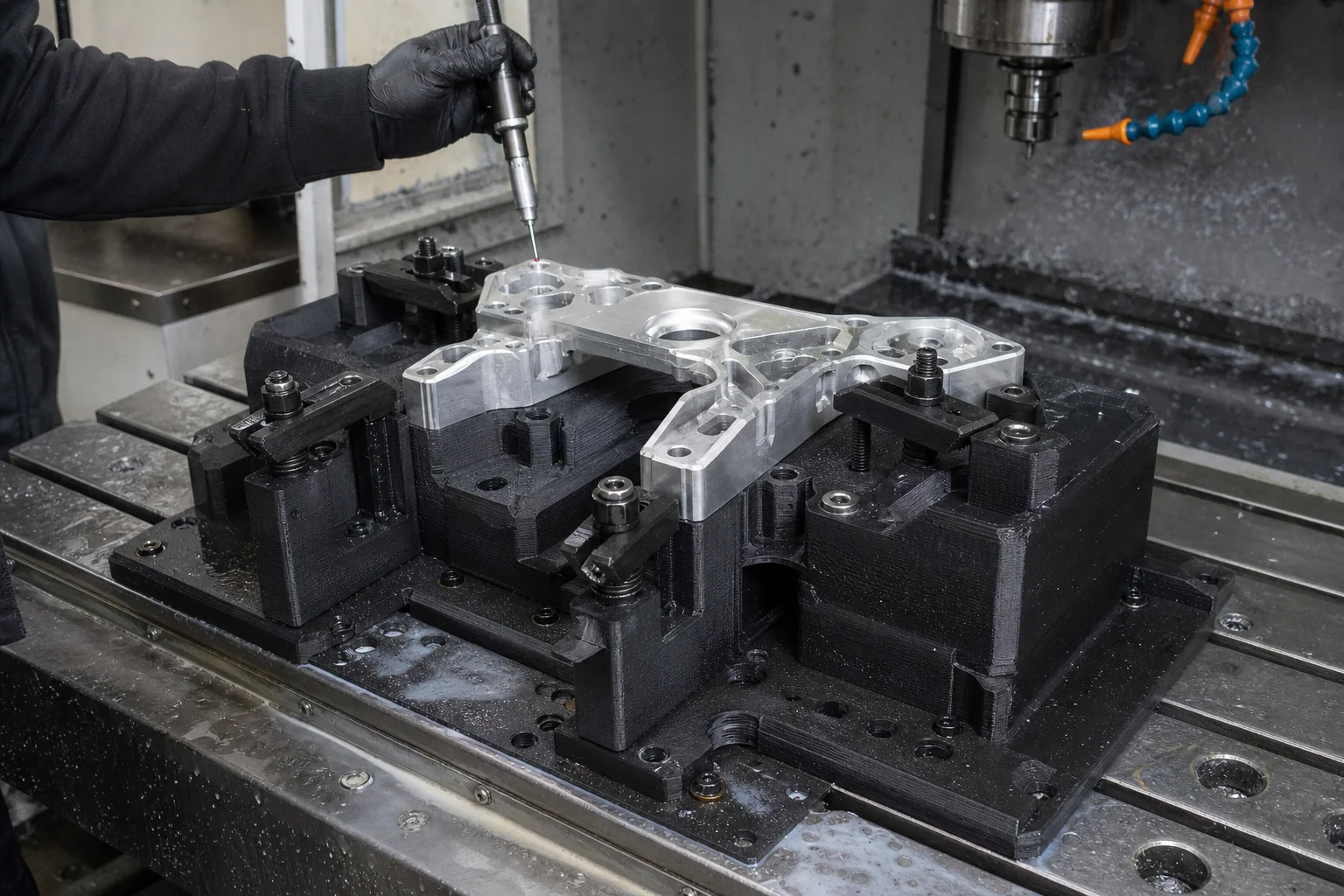
PAHT-CF printed CNC workholding fixture securing an aluminium component in a machining centre
Representative applicationCoolant-exposed CNC workholding with robust locating features

The engineer’s read.

Material family names are not specifications. This page anchors the discussion to a named commercial grade and published printed-specimen data, then translates that data into practical selection and design guidance.

What it brings

PAHT-CF combines long-chain nylon chemistry with carbon fibre to reduce moisture sensitivity while preserving excellent layer adhesion, toughness and thermal performance. It is often the stronger systems choice for fixtures that must remain stable in real workshop humidity.

Selection verdict

Choose PAHT-CF when a carbon-nylon part must hold its properties and dimensions in humid service.

Printed properties.

Orientation, conditioning and geometry can move finished-part performance materially. Use these figures to compare candidate materials—not as guaranteed minimums.

PropertyRepresentative valueTest / context
Density1.06 g/cm³Manufacturer TDS
Tensile strength · dry92 ± 7 MPaManufacturer TDS
Elongation at break · dry8.4 ± 1.8%Manufacturer TDS
Flexural modulus · XY dry4.23 ± 0.21 GPaManufacturer TDS
Flexural modulus · XY wet3.64 GPaManufacturer method
Flexural strength · XY dry125 ± 7 MPaManufacturer TDS
HDT · 0.45 MPa194°CISO 75
Saturated moisture uptake0.88% · 25°C / 55% RHManufacturer method

XY values normally represent flat-printed specimens. Z-direction strength can be substantially lower. Final production settings should be qualified on representative geometry.

Selection logic.

A useful material choice starts with load case, temperature, environment, duty cycle and failure consequence—not the strongest number on a datasheet.

Advantages

  • Excellent wet-state mechanical retention
  • High Z-axis adhesion relative to many fibre composites
  • High heat resistance and low density
  • Lower moisture uptake than PA6-based composites

Watch-outs

  • Still responds to humidity despite improved wet-state retention
  • Costs more than PA6-CF/GF
  • Lower stiffness than PPA-CF and PPS-CF

Strong applications

Humid-environment fixturesRobotics toolingInjection-mould tooling aidsFunctional end-use componentsAutomotive partsHigh-temperature prototypes