
Flexible engineering elastomer
TPU

TPU: A practical hardness spectrum from soft cushioning to tough semi-rigid protection.

TPU is a family rather than one fixed “rubber-like” material. The current filament range spans soft 85A, balanced 90A, firm 95A HF and much harder 68D TPU 68D. The right grade changes cushioning, grip, structural support and deformation far more than the TPU label alone.

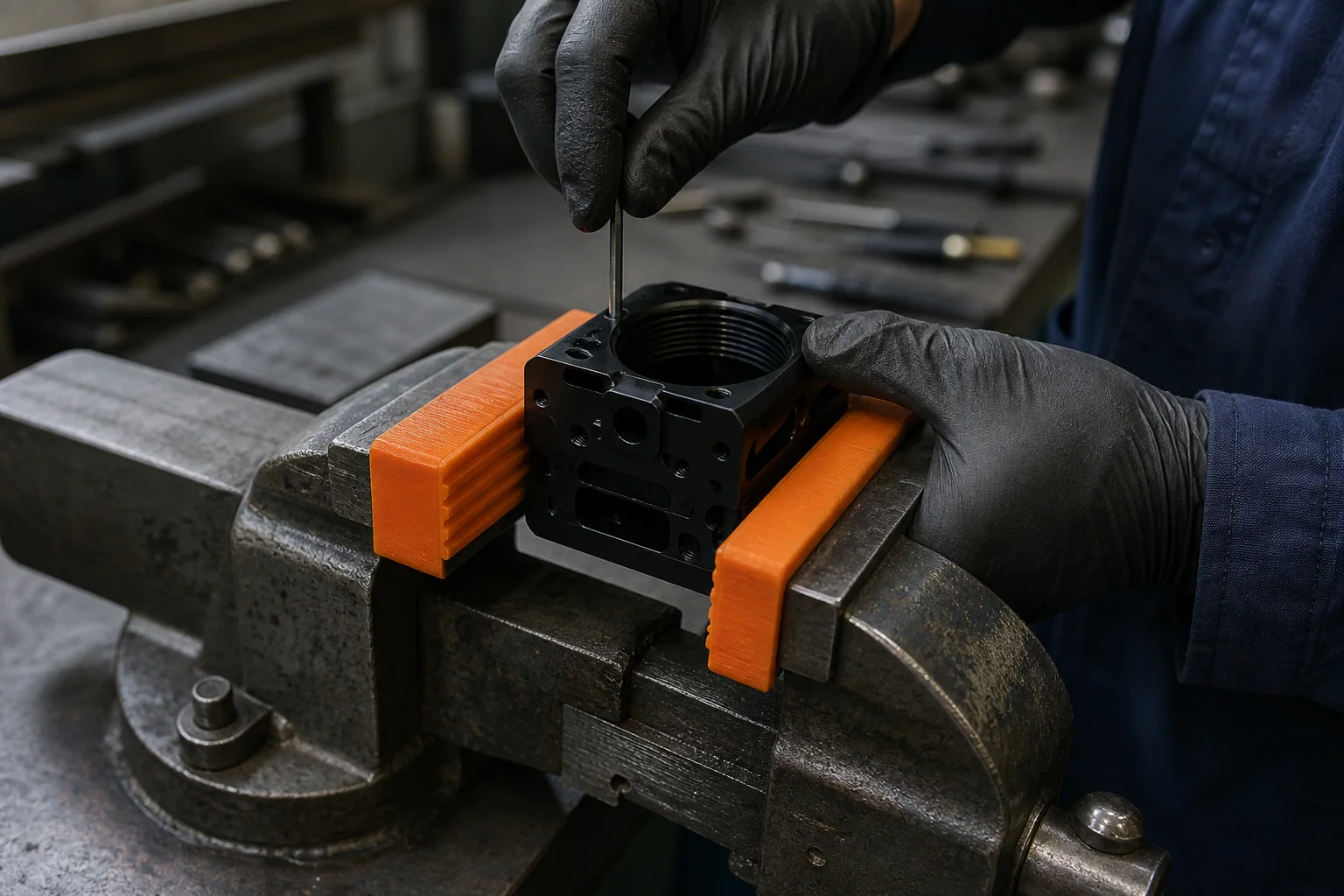
Orange TPU printed soft jaws protecting a black machined component in a workshop vice
Representative applicationCompliant vice jaws protecting finished components during assembly

The engineer’s read.

Material family names are not specifications. This page anchors the discussion to a named commercial grade and published printed-specimen data, then translates that data into practical selection and design guidance.

What it brings

TPU is a family rather than one fixed “rubber-like” material. The current filament range spans soft 85A, balanced 90A, firm 95A HF and much harder 68D TPU 68D. The right grade changes cushioning, grip, structural support and deformation far more than the TPU label alone.

Selection verdict

Choose 85A for maximum cushioning, 90A for soft functional parts, 95A for firm elastic components, or 68D when toughness and semi-rigid support matter more than softness.

Printed properties.

Orientation, conditioning and geometry can move finished-part performance materially. Use these figures to compare candidate materials—not as guaranteed minimums.

PropertyRepresentative valueTest / context
TPU 85A85A · 12.0 ± 0.8 MPa tensile>700% elongation at break
TPU 90A90A · 12.5 ± 0.8 MPa tensile>650% elongation at break
TPU 95A HF95A · 27.3 ± 0.8 MPa tensile>650% elongation at break
TPU 68D68D · 22.4 ± 0.6 MPa tensile>650% elongation at break
Shore-scale contextA and D are different scales68D is materially harder than the A-scale grades

XY values normally represent flat-printed specimens. Z-direction strength can be substantially lower. Final production settings should be qualified on representative geometry.

Selection logic.

A useful material choice starts with load case, temperature, environment, duty cycle and failure consequence—not the strongest number on a datasheet.

Advantages

  • 85A provides the softest cushioning and impact absorption in the range
  • 90A balances flexibility with more shape support for functional components
  • 95A HF suits firm, durable elastic parts with higher published tensile strength
  • 68D TPU 68D moves toward tough semi-rigid protection rather than soft rubber behaviour

Watch-outs

  • Shore A and Shore D values are different scales and should not be compared as a single linear sequence
  • Compression set can govern continuously clamped seals or pads
  • Chemical resistance and long-term flexibility remain formulation- and environment-specific

Strong applications

85A cushioning and soft bumpers90A grips and compliant supports95A seals, couplings and strain reliefs68D impact-resistant covers and guardsFlexible feet and wear padsRobotic compliant interfaces