What it brings
Our nylon is a PA6/66 copolymer available in black and natural. Published product data describes self-lubricating wear resistance, high toughness and low shrinkage. Drying and conditioning remain important for the finished part.

Our nylon is a PA6/66 copolymer available in black and natural. Published product data describes self-lubricating wear resistance, high toughness and low shrinkage. Drying and conditioning remain important for the finished part.
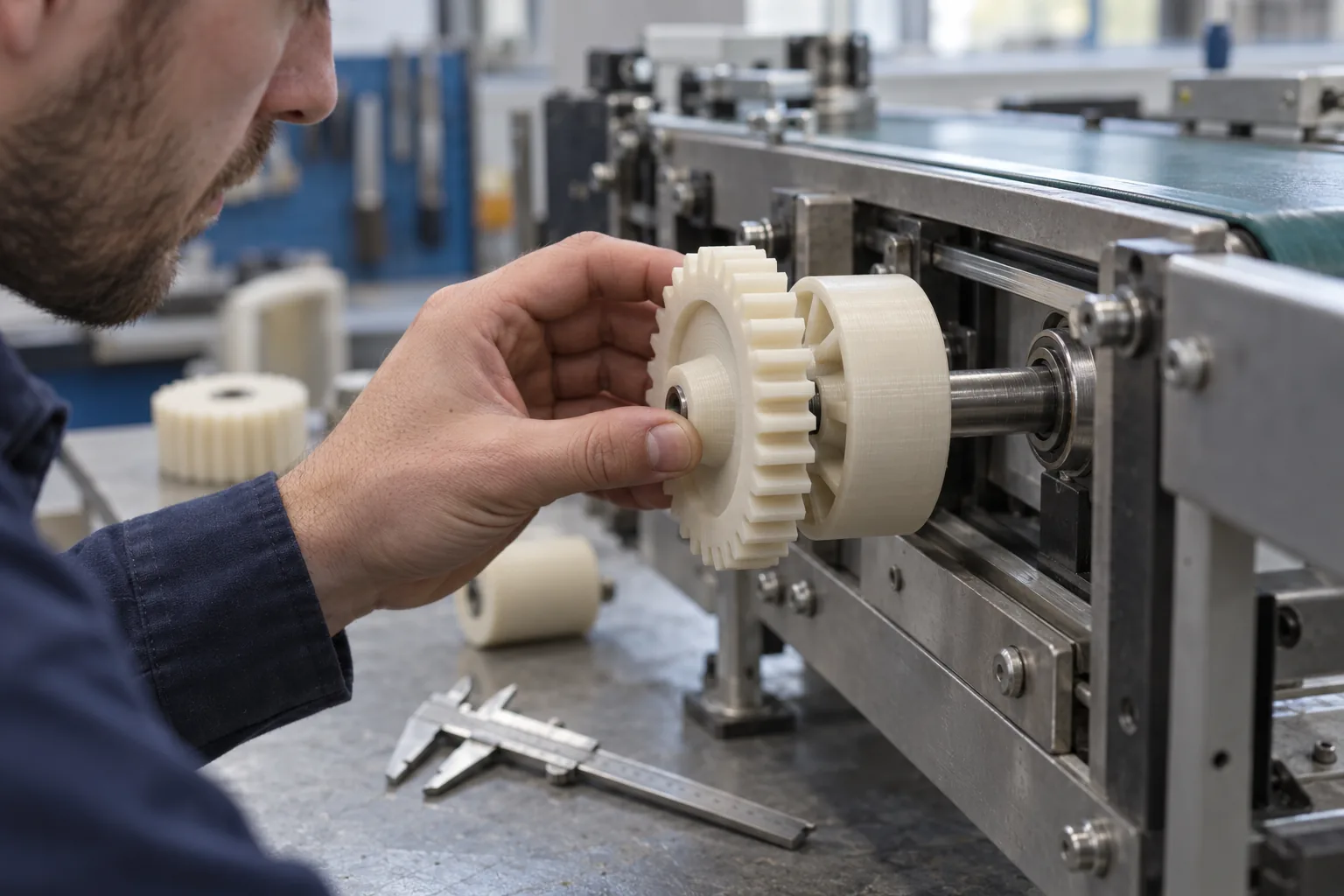
Match the actual part geometry and service conditions to the grade and test context, not just its family name.
Our nylon is a PA6/66 copolymer available in black and natural. Published product data describes self-lubricating wear resistance, high toughness and low shrinkage. Drying and conditioning remain important for the finished part.
Choose nylon for wear-facing or repeatedly handled parts when toughness matters more than stiffness. Confirm the printed geometry and moisture conditioning before relying on a published value.
Nylon PA6/66 copolymer. The 2021 TDS reports 50°C HDT at 0.45 MPa on a moulded specimen; the current product page reports 99.6°C without a matching test context. Do not treat either as a continuous-use rating. Product-page XY strength is 43.64 MPa; the TDS reports 52.45 MPa on a different specimen.
| Property | Representative value |
|---|---|
| Density | 1.12 g/cm³ |
| HDT · 0.45 MPa | 50°C (TDS) |
| Tensile strength · XY | 43.64 MPa |
| Flexural modulus · XY | 1.483 GPa |
| IZOD impact · XY | 75.87 kJ/m² (product page; not comparable with Charpy values) |
Published test-specimen data is for comparison only. Orientation, conditioning, processing and geometry can change finished-part performance. Heat-deflection temperature is a standardised test, not a continuous-use rating.
Practical reasons to choose or avoid this material for a specific part.