
Carbon-fibre reinforced polymer
ABS-CF

ABS-CF: High modulus, low shrinkage and technical finish for rigid indoor components.

ABS-CF combines the familiar post-processing and heat capability of ABS with a large increase in stiffness and improved dimensional stability. It is well suited to tooling, brackets and fixtures that need to feel rigid and machine-like.

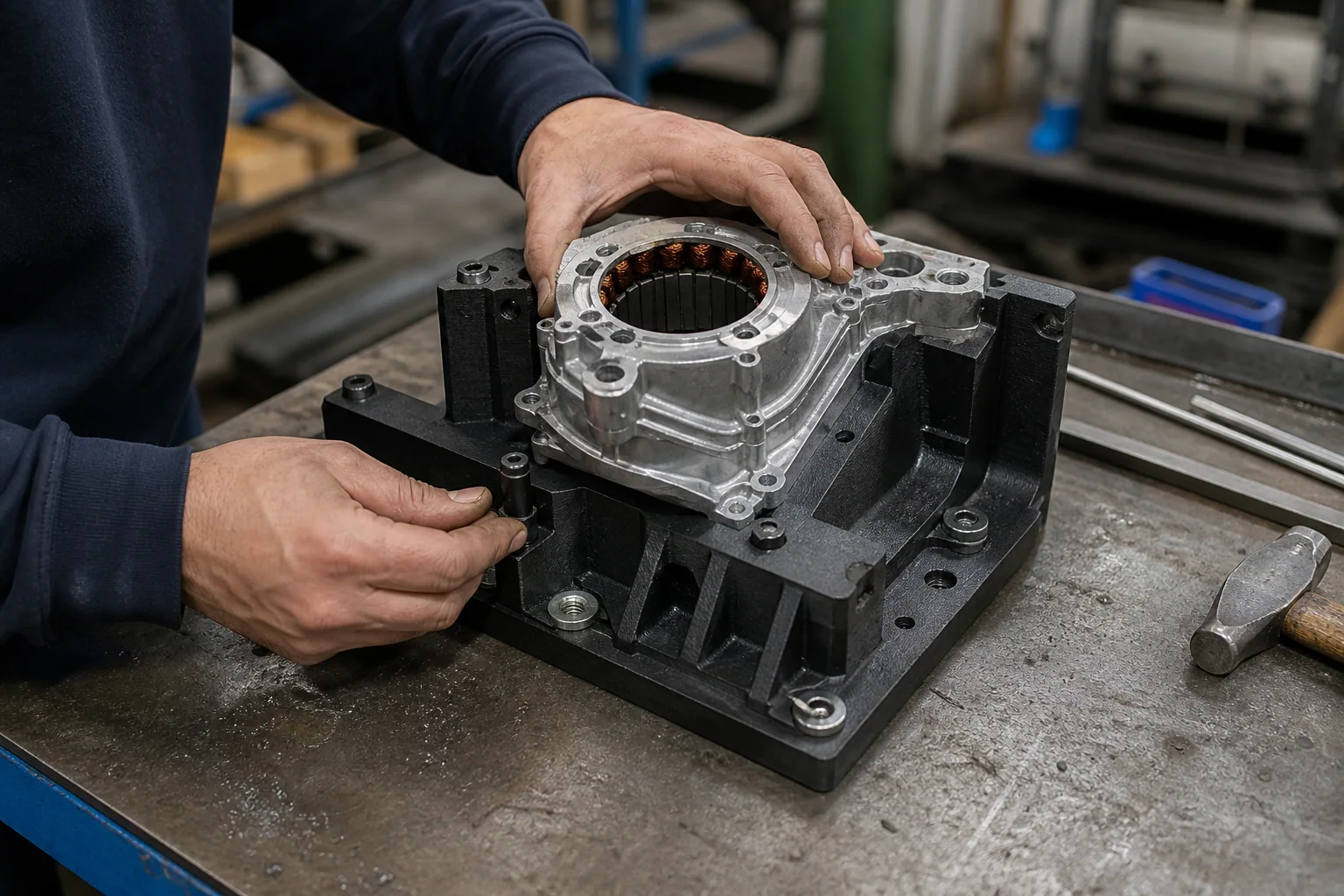
ABS-CF printed assembly fixture locating a machined electric motor housing on a workbench
Representative applicationRigid assembly and drilling fixture for small-batch production

The engineer’s read.

Material family names are not specifications. This page anchors the discussion to a named commercial grade and published printed-specimen data, then translates that data into practical selection and design guidance.

What it brings

ABS-CF combines the familiar post-processing and heat capability of ABS with a large increase in stiffness and improved dimensional stability. It is well suited to tooling, brackets and fixtures that need to feel rigid and machine-like.

Selection verdict

Choose ABS-CF for stiff, dimensionally controlled indoor engineering parts and acetone-finishable tooling.

Printed properties.

Orientation, conditioning and geometry can move finished-part performance materially. Use these figures to compare candidate materials—not as guaranteed minimums.

PropertyRepresentative valueTest / context
Density1.11 g/cm³ISO 1183
Tensile strength · break46 MPaISO 527
Tensile modulus5.21 GPaISO 527
Elongation at break2%ISO 527
Flexural strength76 MPaISO 178
Flexural modulus5.26 GPaISO 178
Glass transition105°CDSC
HDT · 0.45 MPa76°CISO 75

XY values normally represent flat-printed specimens. Z-direction strength can be substantially lower. Final production settings should be qualified on representative geometry.

Selection logic.

A useful material choice starts with load case, temperature, environment, duty cycle and failure consequence—not the strongest number on a datasheet.

Advantages

  • Very high stiffness for an accessible engineering composite
  • Improved dimensional stability over unfilled ABS
  • Acetone vapour smoothing remains possible
  • Good machinability and matte surface quality

Watch-outs

  • Lower ductility and impact tolerance than unfilled ABS
  • Not the preferred long-term UV-exposed material
  • Low elongation makes sharp notches and impact loads important design risks

Strong applications

Assembly fixturesMachine bracketsGaugesIndoor end-use housingsRobotics framesDrilling templates